ACI 318-25 Is Here: What Changed for Reinforcing Steel, and the New CRSI Checklists That Track It
A new edition of the concrete code landed, and CRSI rebuilt its design checklists around it. Here is what actually changed for the bar — and the one field rule that keeps a code transition from turning into a cage built to the wrong detail.
CRSI sent out an announcement this week that lands in the middle of a bigger transition: the Concrete Reinforcing Steel Institute has released its updated Design Checklists and Calculators, rebuilt for the 2025 edition of the ACI 318 Building Code. If you have not been tracking code editions, the short version is that the document that governs how reinforced concrete is designed and detailed was replaced, and the tool that designers use to keep from missing one of its requirements was replaced along with it.
I tie steel. I don't design the structure, and a checklist suite is not a field tool. But there are two reasons a rodbuster should read this story carefully. First, the parts of ACI 318 that changed this cycle are the parts that reach the bar: how long a hook has to be, how a headed bar develops, when a group of closely spaced bars has to be checked for breakout, and what now has to be qualified before post-installed bars can be used. Second, a code transition is the window where a plan set drawn to the old edition gets built by someone working from the new one, and that is how a correct cage ends up wrong.
So here is the change record, with the source next to every claim — and then the rule I would apply on any job where the drawings might have been produced under either edition.
What ACI 318-25 is, and when it arrives
ACI CODE-318-25, Building Code Requirements for Structural Concrete, is the 2025 edition of ACI 318, published by the American Concrete Institute. In a code-update article written by the people who ran the committee that produced it — Andrew Taylor, PhD, S.E., FACI, chair of the ACI 318 building code committee for 318-25, and Greg Zeisler, engineer at ACI and secretary of that committee — the changes are described as a mix of refinement, clarification and coordination: refinement of the one-way shear provisions introduced in ACI 318-19, alignment with the other ACI structural codes (ACI/PCI 319-25, ACI/PTI 320-25 and ACI 440.11-25), coordination with ASCE/SEI 7-22, and improved and clarified construction requirements.
Those same authors list what a designer will notice first: a new appendix for sustainable and resilient design, a new appendix for performance-based wind design, improvements to development length equations for hooked and headed bars, refinements to strut-and-tie modeling, updated prestressed concrete provisions, modified structural integrity requirements, post-installed reinforcing bar provisions, and clarifications to anchor reinforcement requirements.
On adoption: ACI's own reporting on the International Code Council development cycle states that ACI CODE-318-25 will be referenced by the 2027 International Building Code and International Residential Code without modification. What matters for a specific job is narrower than that — a state or local jurisdiction adopts model codes on its own timetable, and whatever edition the sealed drawings cite is the edition the work is built to. On a Pennsylvania pool or addition, the permit set tells you which one you are holding, and it is worth reading that cover sheet before you cut a single bend.
The steel-side changes, in plain terms
The most useful summary for anyone who installs bar comes from STRUCTURE magazine's technical walkthrough of the anchorage and reinforcing-bar provisions in ACI 318-25, written by Kenton McBride, PhD, P.E. The magazine's own summary of the article is that ACI 318-25's anchoring provisions reduce conservatism, clarify usage, and account for reliability and redundancy, plus major updates to breakout calculation of reinforcing bar groups. Here is what that means bar by bar.
- Hooked bar development length: revised, in a way that returns the basic equation closer to the ACI 318-14 form with an added bar-size modifier. The committee reviewed existing hooked-bar test data, in-service performance of hooks designed to earlier editions, and new test data on No. 14 and No. 18 bars.
- Headed bar development length: the ACI 318-19 equation was adjusted in 318-25, which slightly reduced the headed-bar development length.
- A new breakout check on groups of closely spaced bars: a requirement to check tension breakout cone failure of a group of closely spaced reinforcing bars when the group is loaded in tension. That Chapter 25 equation is also permitted, with restrictions, for calculating breakout capacity of anchors under Chapter 17.
- Post-installed reinforcing bars: systems now have to be qualified in accordance with ACI CODE-355.5-24, Post-Installed Reinforcing Bar Systems in Concrete — Qualification Requirements and Commentary.
- Mechanical and welded splices: major changes across several locations, primarily affecting seismic detailing, with some changes touching non-seismic applications as well.
- Headed deformed stirrups: new provisions, including detailing rules and the locations where they may be used.
- One-way shear: a lower bound was added for the concrete contribution to shear strength, and the code reverted to the familiar ACI 318-14 one-way shear equations for certain member classes — cantilever retaining walls, basement walls, pile caps supported on closely spaced piles, and shallow foundations that can reasonably be assumed to be rigid.
- Anchorage to concrete: strength-reduction factors for anchors moved to Chapter 21; anchor capacity now includes a modifier that can increase capacity where an anchor sits inside a concrete compression field; supplemental reinforcement, and shear-tension interaction, were clarified.
That last group is engineer territory, not mine. But the first four items in that list are the ones that decide how long a piece of steel has to be and whether it is even permitted on the job.
Hooked bars: the change most likely to reach a pool shell
ACI 318-19 introduced a hooked-bar development length equation that raised the bar diameter to a power of 1.5, which is a stiff penalty as bar size grows. The committee went back through the test data, and Taylor and Zeisler describe where it landed:
“The committee concluded that hooked-bar development length equations from ACI CODE-318-14 and earlier were appropriate, except the older equations didn't adequately represent the data for No. 10 and larger bars. Thus, ACI CODE-318-25 contains the hooked-bar development length equation from ACI CODE-318-14 with a new modifier for bar size.”
Read that as a design consequence: a standard hook drawn under the new edition can come out shorter than the same hook drawn under 318-19, while the largest bars are handled by the new size modifier. Independent development-and-lap references have already picked that up, describing standard hook development length in 318-25 as typically shorter than in the previous edition.
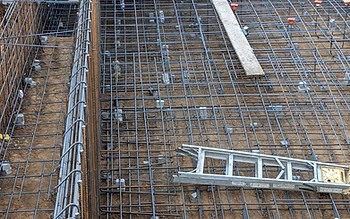
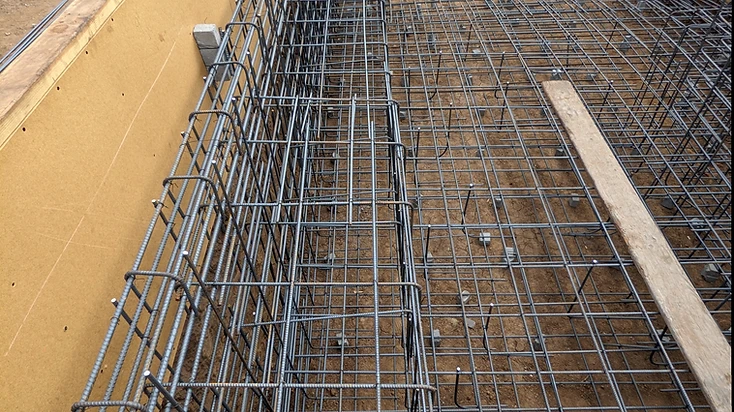
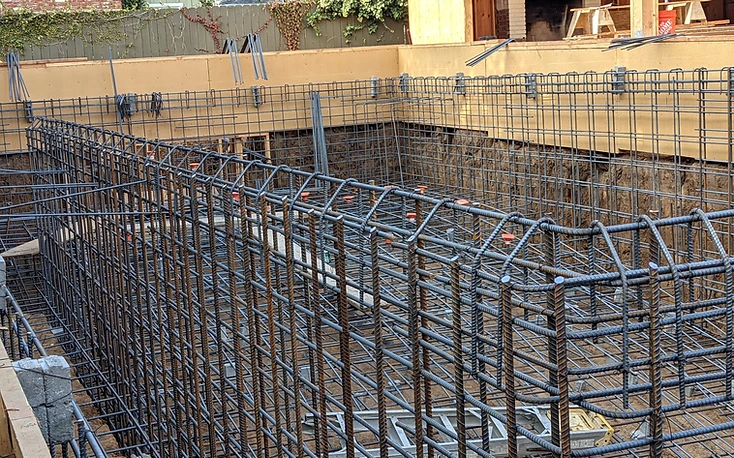
Why a rodbuster should care: hooks on a pool shell are not decorative. They show up at bond-beam corners, at the top of a wall curtain where it ties into the bond beam, at the dam wall between a pool and a spa, at a cover box, at step and bench returns, and at every dowel bent into the existing structure. If a bar is cut and bent to one edition's hook length and the drawing was made under the other, the installed hook is either longer than it needed to be — wasted steel and a bend that may not fit the formwork — or shorter than the design required, which is not a field judgment call anyone should be making.

Closely spaced bars and the dowel work
Two of the changes are worth naming on their own, because they touch work that a reinforcing installer does hands-on.
The first is the new tension breakout check on groups of closely spaced bars. Until now, a cluster of bars developing tension near a concrete face was largely covered by the same anchorage rules as anything else. ACI 318-25 requires the designer to check whether that group can break out the concrete around it, and per STRUCTURE magazine the same Chapter 25 equation may be used for anchor breakout design under Chapter 17, subject to restrictions — the kc factors stay at the Chapter 17 values rather than the higher Chapter 25 factors, the cracking factor ψc,N may be taken greater than 1.0 in accordance with Chapter 17, and the ψa factor applies.
The second is post-installed reinforcing bars. Retrofits, extensions and dowels into existing concrete are a real part of this trade, and under ACI 318-25 the systems used for them have to be qualified to ACI CODE-355.5-24. That is a documentation requirement as much as a technical one, and it is the kind of thing that gets asked for at submittal — adhesive system, evaluation report, qualification. If a plan calls for post-installed dowels, that paperwork is now part of the package.
What else moved: shear, splices, and the rest
For completeness, because a code edition change is never one clause.
“The revisions in ACI CODE-318-25 added a lower bound for the value of the concrete contribution to shear strength.”
- Reversion to ACI 318-14 one-way shear equations for cantilever retaining walls, basement walls, pile caps on closely spaced piles, and shallow foundations reasonably assumed rigid — the member classes where the newer provisions were not tracking the research as well.
- Prestressed concrete: changes to the required concrete strength at initial transfer of prestress, and removal of the approximate shear method.
- Structural integrity requirements updated, based on laboratory data on perimeter beams aimed at reducing the chance of disproportionate collapse if a perimeter column is lost.
- Strut-and-tie modeling: revised detailing requirements to help determine reinforcement outside the assumed strut-and-tie model.
- Concrete deep foundations: provisions expanded and clarified, continuing work that started with the 2019 edition, toward one unified set of design and detailing provisions for all concrete deep foundation types.
- Seismic provisions: a long list of clarifications to requirements introduced in 2019 — diaphragm design strength, special moment frame detailing, shear amplification for special walls, special wall reinforcement detailing and shear strength, and redistribution of shear forces among coupling beams.
- New pattern live load requirements for elevated slabs containing large internal voids, such as embedded ducts.
- Steel-fiber-reinforced concrete provisions updated to align with the modified shear provisions.
- Interaction and shear-friction provisions clarified in several locations, including the separation of concrete and steel failure modes in anchor shear-tension interaction — concrete failure modes interact with concrete, steel with steel, which removes a conservative simplification that was producing inefficient designs.
The anchor safety-factor change is the one with the sharpest edge in it, because it cuts both ways. Under ACI 318-25 the ϕ factors for anchor design moved into Chapter 21, the anchor category and supplementary-reinforcement adjustments were split out into a new modification factor, ψa, and a distinction was drawn between redundant and non-redundant fastenings. Per STRUCTURE magazine's analysis, the resulting ϕ·ψa product for redundant connections is roughly equivalent to the 318-19 ϕ factors, while capacities for non-redundant connections drop by 10 to 15 percent. Redundancy, in that context, means an engineer can demonstrate that failure of a single anchor does not cause loss of position retention or progressive collapse.
The CRSI suite: what you actually get
CRSI's new suite is the reason this code change reached my inbox at all. The Design Checklists are lists of the essential items that have to be completed when designing and detailing steel-reinforced concrete members, organized so nothing in the code gets skipped by accident. CRSI's own framing for why the rebuild matters is the gap between editions:
“The fourteen Checklists, which are in a single wire-bound volume with tabs, assure that all requirements for a specific structural member are addressed and not inadvertently skipped or forgotten. This is vitally important given the many revisions that occurred between the 2019 and 2025 editions of ACI 318.”
- Fourteen checklists covering the structural members, gathered into one coil-bound volume with quick-reference tabs.
- Each checklist carries the code-prescribed requirements and section numbers, plus design aids and enhanced tables and figures on how to interpret and apply them.
- Eighteen Excel calculators that speed up the checking procedure — completely updated and reformatted, with page layouts that print cleanly into a calculation package.
- All macros removed: the calculators are now 100 percent macro-free, which is a real change for anyone who has had a spreadsheet flagged or blocked on a corporate machine.
- Imperial units, as the publication notes.
- Three formats: printed hardcopy, a one-device digital license, or the print-and-digital bundle. The CRSI store listed the printed suite at $199.95 and the bundle at $249.95 when I looked in October 2026 — CRSI prices member and non-member differently, so the store is the place to check.
- Stated audiences: design professionals, plus plan checkers, building officials, professors and students, and engineers studying for licensing exams.
The checklists can be used two ways, according to CRSI: to verify calculations or construction documents efficiently, or as a step-by-step design procedure for a given member. That second use is the one that explains why the suite sells beyond design offices — a checklist that walks the code requirements in order is also a study document and a plan-review document.
What I'd use it for on a steel job
Being honest about the boundary: this is a designer's tool. The engineer of record specifies the reinforcement; I install what the drawings call for. A contractor buying a checklist suite to override a sealed drawing would be doing exactly the wrong thing with it.
Where it earns its place in my truck is as a cross-check before the steel is cut and bent. When a plan set shows hook details, lap splices and dowels, walking the requirements in order tells you whether the lengths on the drawing are consistent with the edition it cites, and whether something the plan omitted — a breakout condition at a cluster of bars, the qualification for a post-installed system — needs to go back to the engineer as a question. That is the same discipline I have described elsewhere on this site: read the plan before touching steel, and take the questions to the person who owns the design instead of solving them quietly at the bottom of an excavation.
The field rule for a code transition
Here is the rule I would apply on any job today, while two editions of ACI 318 are both live: build to the edition the sealed drawing cites, and never mix details from one into the other.
In practice that means three habits. Check the code edition on the drawings before takeoff, not after the bar is bent. Treat a hook or lap length that looks short against the other edition as a question for the engineer of record rather than a convenience. And when a plan calls out a post-installed system, ask early for the qualification documentation, because ACI 318-25 now requires it and it belongs in the submittal, not in a scramble the week of installation.
None of that is complicated. It is the same discipline as anything else in this trade: the drawing governs, and the person holding the pliers is responsible for knowing what they are building to.
The bottom line
- ACI CODE-318-25 is the 2025 edition of the concrete code, and per ACI's reporting it is slated to be referenced by the 2027 IBC and IRC. Jurisdictions adopt on their own schedules — the edition on the permit set is the one that governs your job.
- The bar-side changes are hooked and headed bar development length, a new tension breakout check for groups of closely spaced bars, and new qualification requirements for post-installed reinforcing bar systems under ACI 355.5-24.
- Hooked-bar development in 318-25 returns to the 318-14 basic equation with a new bar-size modifier, so many standard hooks come out shorter than they did under 318-19.
- CRSI's rebuilt suite is 14 checklists in one tabbed, coil-bound volume plus 18 macro-free Excel calculators, in printed, digital or bundled form.
- For an installer, the takeaway is a discipline rather than a document: know which edition your drawings were drawn to, don't mix hook and lap details across editions, and route anything that looks off to the engineer of record before the steel is cut.
Common questions
What is ACI CODE-318-25?
It is the 2025 edition of ACI 318, Building Code Requirements for Structural Concrete, published by the American Concrete Institute. It is the document that governs how reinforced concrete structures are designed and detailed, and it coordinates with the other ACI structural codes (ACI/PCI 319-25, ACI/PTI 320-25, ACI 440.11-25) and with ASCE/SEI 7-22. The 2025 edition refines the one-way shear provisions introduced in 2019, revises the hooked and headed bar development length equations, adds a tension breakout check for groups of closely spaced reinforcing bars, and adds qualification requirements for post-installed reinforcing bar systems.
When does ACI 318-25 take effect?
ACI published the 2025 edition, and ACI's own reporting on the ICC code-development cycle states that it will be referenced by the 2027 International Building Code and International Residential Code without modification. That is not the same as taking effect on a job. Building codes are adopted by state and local jurisdictions on their own timelines, so the edition that governs a project is the one cited on its sealed drawings and required by the authority having jurisdiction — check the permit set rather than assuming.
Did hooked bar development length change in ACI 318-25?
Yes, and it is one of the changes most likely to affect a concrete job. ACI 318-19 used a hooked-bar development length equation in which the bar diameter was raised to the power of 1.5. The 318 committee reviewed existing hook test data, the in-service performance of hooks designed to earlier editions, and new test data on No. 14 and No. 18 bars, and concluded the ACI 318-14 and earlier equations were appropriate — except that they did not represent data well for No. 10 and larger bars. ACI 318-25 therefore carries the ACI 318-14 hooked-bar equation with a new bar-size modifier, which in practice means many standard hooks come out shorter than they did under the 2019 edition.
What changed for post-installed reinforcing bars?
ACI 318-25 requires post-installed reinforcing bar systems to be qualified in accordance with ACI CODE-355.5-24, Post-Installed Reinforcing Bar Systems in Concrete — Qualification Requirements and Commentary. In practice that means the adhesive or mechanical system used for dowels, extensions and retrofits has to be backed by qualification documentation, which is typically requested at submittal. Alongside it, ACI 318-25 adds a requirement to check tension breakout cone failure of a group of closely spaced reinforcing bars when the group is loaded in tension.
What is the new CRSI Design Checklist Suite for ACI 318-25?
It is CRSI's rebuilt set of design and detailing checklists for steel-reinforced concrete, updated for the 2025 ACI 318 edition. The suite contains 14 checklists in a single wire-bound volume with quick-reference tabs, each with code-prescribed requirements, section numbers, design aids and enhanced tables and figures. It includes 18 Excel calculators — completely updated and reformatted for printing into a calculation package, with all macros removed — and comes as a printed hardcopy, a one-device digital license, or a print-and-digital bundle. The store listed the printed suite at $199.95 and the bundle at $249.95 in October 2026.
Does the new code change how rebar is installed on my project?
Only through the drawings. The engineer of record specifies the reinforcement, and the installer builds to the sealed plan set — so the practical effect of a code edition change is that the details on drawings produced under different editions can differ, especially hook lengths, lap lengths and anchorage at clustered bars. The rule for the field is simple: build to the edition the drawings cite, never mix details from one edition into a set drawn to the other, and take anything that looks inconsistent back to the engineer before the bar is cut. ACI 318-25 now also requires post-installed bar systems to carry ACI 355.5-24 qualification, which belongs in the submittal.
A second-generation rodbuster carrying a family reinforcing-steel lineage from Southern California to southeastern Pennsylvania. A family reinforcing-steel lineage dating to 1986 — now building in southeastern Pennsylvania.