The Materials Coming for Rebar's Job: FRP, Steel Fiber, ICF and What Actually Works
Foam blocks that build a house wall, plastic bar that never rusts, concrete that flows out of a nozzle — I went through the standards, the research and the vendor pricing to see which of them can actually take work away from steel. Most of them cannot. A few genuinely can, in specific places, and every pool builder should know where the line is.
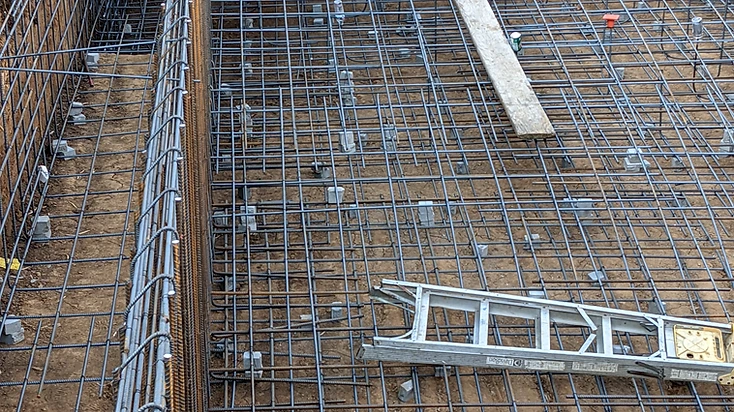
Every few months somebody sends me a video — a machine printing a house out of a nozzle, a stack of foam blocks going up where a foundation wall used to be, a bar that bends in your hands like a fishing rod — and asks the same question. Is this the end of rebar?
The foam blocks have a name, and it is the one people most often forget: insulated concrete forms, or ICF. Here is the detail that never makes the video. An ICF wall is a concrete wall. The foam stays in place and becomes the insulation, the concrete core carries the load, and inside that core there are horizontal and vertical reinforcing bars, placed by a rodbuster, before the pour. The foam replaced the plywood formwork, not the steel.
That is the pattern across almost this whole category, and it is why I wanted to write this properly rather than react to the next video. I read the standards that govern each material (ACI and ASTM where they exist, FHWA where they do not), the manufacturers' own literature, published research, and current vendor pricing. Where a number comes from somebody selling the product I say so, because a supplier's price guide is a fact about a price and a supplier's performance claim is marketing.
The short answer, before the long one
Rebar alternatives exist. Rebar replacements — a material that does the same job in a structural concrete member, without steel bar — do not, not in anything you or I will pour this decade. What does exist is a set of materials that take specific work away from steel in specific places, plus one whole category of construction that removes the concrete member entirely.
- Nothing on this list replaces structural steel bar in a shell, a wall, a footing or a mat today. Not one of them has a code path that lets an engineer sign off on a residential pool shell without bar.
- The materials genuinely winning work are winning it where steel fails: salt water, deicing salt, chemical plants, wastewater, and rooms where magnetism is a problem. That is a corrosion story, not a strength story.
- What actually changes how many tons a job needs is unglamorous: stronger concrete, post-tensioning, and better detailing.
- For a residential pool, the biggest competitor to a reinforced shell is not a new material at all. It is a different kind of pool, and I will get to that, because it is the honest answer nobody wants to hear.
The foam blocks are called ICF — insulated concrete forms
Insulated concrete forms are hollow blocks or panels of expanded polystyrene, stacked like large masonry to the shape of a wall. Vertical and horizontal reinforcing bar goes inside the hollow, the cavity is filled with concrete, and the foam is left there for good. The finished assembly is a reinforced concrete wall with insulation bonded to both faces and furring strips ready for drywall on the inside and siding on the outside.
Core sizes run from roughly four inches to twelve, and the choice matters more for structure and thermal mass than for R-value — ICF Builder Magazine makes the point that the foam provides the insulation while the concrete provides mass, so a bigger core buys strength and thermal mass rather than a better R number. Published systems list whole-wall ratings in the R-22 to R-30 range depending on the foam configuration. The method is established enough that HUD published a prescriptive design method for ICF walls covering the reinforcement, and local codes have referenced that approach for decades.
I want to be fair to it, because it is a good system. What it does well:
- Simple, repetitive walls go up fast, and the foam doubles as the form, the insulation and the furring in one assembly — fewer trades and fewer trips around the building.
- Air sealing comes nearly free, because the wall is one continuous concrete pour behind continuous foam.
- Fire and storm performance are genuinely better than a framed wall, and the mass quiets a house.
- Square, plumb, straight walls are easy to hit, which is why basements and foundation walls are where ICF makes the most sense.
Where it bites:
- Bracing and blowouts. A wall full of wet concrete pushes hard, and a form that lets go at the wrong moment ruins a pour. Every ICF contractor has a story, and every ICF video channel has a video.
- Cost. The blocks, the bracing rental, the extra concrete and the learning curve all land on the front end, and the savings arrive over years of energy bills.
- Anything that is not a straight wall gets slow. Curves, tight radii, changes in wall thickness and complicated openings all fight the module.
- Modifying a finished ICF wall later means cutting concrete and foam, and details like termite provisions, waterproofing transitions and exterior cladding attachment all need to be designed rather than improvised.
ICF pools: the version of this that actually touches our work
ICF is not just for houses. There is a real, small category of pool built this way: foam block walls stacked to the pool shape, steel placed in the cores, concrete pumped in, then waterproofing and finish over the top. Manufacturers in that space claim the foam cuts heat loss from the pool dramatically, and it is an honest advantage — an insulated shell holds temperature better than a bare one.
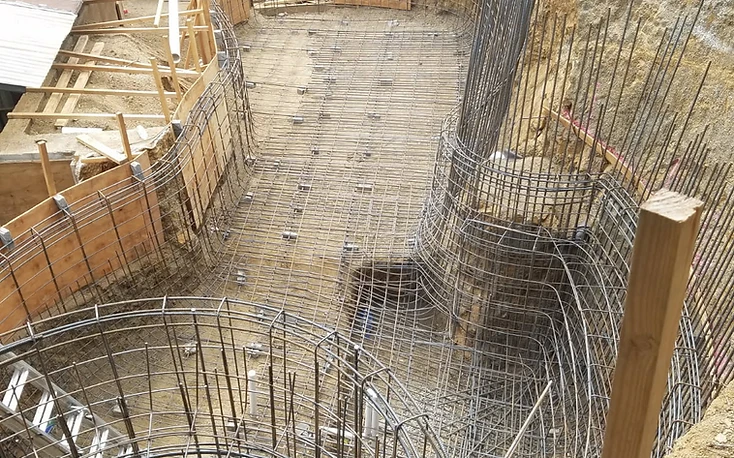
The reason it has not taken over is geometry. A pool built from block modules is a pool made of straight runs and manufactured corners. The work I do is free-form: continuous radius changes through the walls, a raised bond beam that curves, an infinity edge that has to be level to a fraction of an inch over thirty feet, a sun shelf, a separate raised spa, a bench inside the deep end. That is a shell shaped by bent bar and shotcrete, because bar bends to whatever the drawing says and a foam block does not.
So on a rectangular pool with simple walls, an ICF build is a legitimate competitor and I would not argue with it. On the pools that make up most of my work, the method has no answer — and the steel inside it is still mine.
Fiber-reinforced polymer bar: the one real challenger
Glass fiber-reinforced polymer bar, GFRP, is the alternative that deserves the word. It is glass fiber in a resin matrix, formed into a bar with a sand-coated or helically wrapped surface for bond. It is about a quarter the weight of steel, it does not corrode, it is not magnetic, and you can cut it with a saw. For a structure that lives in salt, it solves the problem that ruins steel.
Unlike basalt, glass bar has a real code path. ASTM D7957 is the product standard for solid round GFRP bars, and ACI 440.1R is the design guide. ACI published CODE 440.11-22, building code requirements for structural concrete reinforced with GFRP bars meeting D7957, and the 2024 International Code Council model codes reference it — which is the moment a material stops being an experiment and starts being a design option an engineer can specify.
- Tensile strength along the fiber runs roughly 100 to 170 ksi, which is high — higher than a #4 Grade 60 bar.
- Modulus of elasticity runs roughly 6,000 to 8,000 ksi against about 29,000 ksi for steel. It is, in plain terms, a limper material, and that one number drives most of the design consequences.
- It does not yield. Steel gives warning before it fails; GFRP goes from elastic to broken.
- ASTM D7957 requires a minimum mean glass transition temperature of 212°F, which is the material's own way of telling you that heat matters here.
Price is the wall. Vendor and distributor comparisons put GFRP bar in the range of 10 to 30 percent above equivalent steel bar, and basalt bar in the range of 20 to 30 percent above steel per ton — both figures come from companies that sell the product, so treat them as the optimistic end. In a corrosive environment that premium can pay back, because the steel alternative there is epoxy-coated, galvanized, or stainless, and those are not cheap either.
Where FRP wins, and the five things it cannot do
FRP is already the right answer in bridge decks and barriers exposed to deicing salt, marine structures, seawalls and bulkheads, wastewater and chemical plants, tunnel linings, and any building where a magnetic field cannot tolerate steel. Those are real markets, and they are growing at double-digit rates by the market researchers' count.
What it cannot do is just as concrete, and this is the part the videos leave out:
- It cannot be bent in the field. Every hook, every 90, every radius is manufactured at the plant and shipped. On a pool shell, where nearly every bar in the wall is bent to a radius that changes, that is close to fatal.
- It does not lap to steel. You design an FRP member as an FRP member; you cannot substitute a few bars and leave the rest.
- It is deflection-governed, not strength-governed. Because the modulus is roughly a quarter of steel, an FRP member designed to the same load usually needs more bar area or a deeper section. The material is stronger and the member is not automatically lighter.
- Failure is brittle and fire behavior is different from steel, so cover, crack width and temperature limits are part of the design, not an afterthought.
- There is no scrap value and no established recycling path, and an inspector who has never seen it will ask questions the drawings have to answer.
Basalt and carbon: same family, two very different price points
Basalt fiber bar is made the same way from melted basalt rock. It handles alkali and high temperature better than glass, and it is often marketed as the natural-fiber alternative. The honest caveat is code: as of this writing there is no US product standard or ACI design code for basalt bar comparable to D7957 and CODE 440.11 for glass, which means an engineer specifying it is working from test data and judgment rather than a code path. That is not a reason to dismiss it. It is a reason it will not be on a residential pool drawing soon.
Carbon fiber bar is the high-performance end: much stiffer and stronger than glass, used for prestressing, for repair, and where weight and corrosion both matter. ACI publishes a material specification for carbon FRP bar (SPEC 440.6). It also costs multiples of steel, which is why you see it on bridges and not on pool decks.
Steel fiber: what it replaces, and what it never will
Steel fiber is not a bar at all. It is short strands — typically 30 to 100 pounds per cubic yard — mixed into the concrete, where they bridge cracks and add toughness. ACI 544 is the body of knowledge here, and the industry has published a conversion approach for swapping welded wire mesh or light bar mats for a fiber dosage based on tensile capacity.
That conversion is real and it is useful, and it applies in a narrow band: slabs on grade, where the steel's only job is to hold cracks together between joints; shotcrete, where fibers do excellent work in a thin layer; and some precast elements. It does not apply to a footing, a retaining wall, or the wall of a pool, because a fiber has no continuous path through the member. Fiber controls cracking. Bar develops tension. Those are different jobs.
This matters most on the work I actually do. Fiber-reinforced shotcrete is common and good on pool shells, and I have no argument with a fiber dosage in the mix. It does not remove the cage. The cage is what carries the bending in the wall, ties the bond beam together, and holds the shell when the soil on one side moves and the water on the other side does not.
The drawbacks are practical rather than structural: fibers ball up in the mixer if dosed or added carelessly, they make a slab harder to finish, and a badly finished surface leaves whiskers standing up that turn into a call-back. None of that is a reason not to use them. All of it is a reason to know what the fiber is there for.
Ultra-high performance concrete: fewer bars, never zero
UHPC is the material that most deserves the word futuristic. FHWA defines the class as cementitious composites with discontinuous fiber reinforcement and compressive strength above 21.7 ksi — roughly two to three times ordinary concrete, with tensile ductility that ordinary concrete does not have. Because of that, a UHPC member can be dramatically thinner and use far less bar.
Where it is actually used tells you what it is for: field-cast joints between precast bridge elements, thin bridge deck overlays, connections in accelerated bridge construction, and repairs where a small volume of very expensive material saves a large volume of disruption. It is not a wall material for a house or a pool, and the reason is price and control — the material costs many times what conventional concrete does per cubic yard, and it demands careful batching, mixing and curing to get the properties you paid for.
3D printed concrete: the reinforcement problem nobody has solved
Printed concrete is the most impressive to watch and the least mature structurally. A printer lays down bead after bead of mortar-like material to build a wall, layer by layer. What it cannot do — yet — is put a continuous reinforcing bar inside that bead. A printed wall is, by itself, unreinforced concrete in a shape with very little capacity to resist out-of-plane bending or shear, which is exactly the load a wall takes from soil, wind or a roof.
So the industry works around it. The common answer is a printed wall with a hollow core that is later filled with conventional reinforced concrete, or post-tensioning, or a robot that lays mesh between passes. A 2026 review of 3D concrete printing standardization puts the state of it plainly: printed elements that do carry reinforcement still have to be designed for flexural and shear capacity, and the behaviour of interlayer reinforcement is not well studied. That is a research gap, not a marketing gap.
Which means printing does not remove the rodbuster. It moves him later in the schedule and into a cavity that is harder to work in. On the low-rise walls where printing competes today, the reinforcement question is the reason it has not gone further.
Low-carbon concrete, and what it does to the steel inside
Cement is the emissions problem, not steel. Chatham House put it at more than four billion tonnes of cement a year and roughly 8 percent of global CO2 emissions. That is why geopolymer and alkali-activated binders, which can cut the cement content hard, are the most funded research in the field.
Here is the catch for anybody in reinforcement: steel's protection in concrete depends on the concrete. Ordinary Portland cement concrete is alkaline, and that alkalinity passivates the bar. Lower-alkalinity binders carbonize faster, and carbonation drops the pH at the steel. Chlorides do the same thing faster. So a low-carbon mix and a steel bar are not automatically a happy pair, and the literature on that interaction is unsettled enough that some low-carbon systems are paired with FRP or with corrosion inhibitors instead.
The other side of the ledger is that steel has been improving on its own. Epoxy coating, galvanizing, stainless, and high-chromium low-carbon bar all exist and all work — with one honest caveat from the field: an epoxy coating that gets damaged in handling or at a bend protects nothing at the damaged spot, and every one of us has pulled rusted epoxy bar out of a bundle and said nothing about it.
What actually competes with rebar on a residential pool
If the question is what takes work away from me, the answer is not FRP. It is a fiberglass shell. A molded fiberglass pool arrives on a truck as one piece, gets set into an excavation in a matter of days, and contains no reinforcing steel at all. Vinyl-liner pools over polymer or steel panels are the same story at a lower price.
I will give fiberglass its due, because the builders who sell it are not wrong about the advantages: a factory shell has a known finish, installation is fast, and there is no shotcrete cure or plaster start-up. The limits are equally concrete, and pool builders on both sides of the argument list them the same way — a finite catalogue of shapes and sizes set by what fits on a truck, repairs that mean cutting the shell rather than patching plaster, gelcoat fading, and a shell that has to be set on a properly prepared base or it will not behave.
What a fiberglass shell cannot be is custom. It cannot be free-form to your yard. It cannot have a raised bond beam curved to a radius, an infinity edge, a sun shelf molded into the entry, or a separate raised spa tied structurally to the main body. That is not a knock on the product — it is the product's definition. The moment a client wants the shell shaped to the site, the conversation is over and it is a reinforced shell again, with bar in it.

Automation: the technology coming for our job, not our material
The most serious change to reinforcing steel is not a material. It is a robot. TyBOT, from Advanced Construction Robotics, drives itself across a mat, finds the bar intersections with cameras and ties them, at a published rate of more than 1,200 ties an hour, in 100, 50 or 33 percent patterns, day or night, rain or heat. It ties black, epoxy-coated, galvanized, stainless and fiberglass bar. A companion machine, IronBOT, places bar. The company now sells them outright as well as running them as a service.
Read that against the tying-gun review I wrote earlier and the picture is clear. A gun made one person faster. A robot makes the mat itself faster, and the crew that used to tie it moves on to setting bar or to the next job. That is a genuine change to the business model of a steel contractor on high-volume flat work, and it is the single technology on this whole list I would bet on.
It also, note, makes steel more competitive rather than less. Cheaper tied steel is a stronger argument against every alternative in this article.
The scorecard
- ICF — replaces the formwork and the insulation, not the bar. Good on straight walls and basement foundations; poor on complex geometry; the pool version still needs a rodbuster inside the foam.
- GFRP bar — the only real substitute, and only where corrosion is the governing problem. Code path exists (ASTM D7957, ACI 440.1R, CODE 440.11). Roughly 10 to 30 percent material premium by vendor figures, thicker sections, no field bending.
- Basalt bar — promising properties, no US design code yet, price premium above glass. Watch it; do not specify it on a house yet.
- Carbon bar — high performance, high price, bridges and prestressing. Not a pool material.
- Steel fiber — removes mesh from slabs on grade and does good work in shotcrete. Never removes the structural cage.
- UHPC — far fewer bars in a specific joint or overlay, at many times the cost per yard. Bridge work, not residential.
- 3D printed concrete — prototype scale for single-storey walls; reinforcement is the unsolved problem, so the bar still goes in.
- Fiberglass and liner pools — genuinely eliminates rebar on a job, but only for shapes a mold or a panel system can make. This is the competitor that actually costs us work.
- Robotics — does not replace steel, makes it cheaper to install. The one to take seriously.
The bottom line
- If you were told the foam blocks replace rebar, you were told wrong. They replace the plywood, and there is bar in the wall.
- FRP bar works and it is here to stay, in the environments where steel is the wrong choice. It is not a cheaper bar and it is not a bendable one, which is why it will not appear on a free-form pool drawing.
- Fiber is a crack-control tool. Anybody who tells you it replaces the cage in a wall, a footing or a shell is selling something they do not understand.
- The real competitive threat to a reinforced shell at the low end of the market is a fiberglass or liner pool, and the answer to it is geometry — the shapes those products cannot make.
- The biggest change coming for our trade is a machine that ties faster, not a material that makes bar unnecessary.
- And whatever gets invented, the part that fails is still the part nobody inspected: cover, laps, bar position, and steel that was set right before it was tied.
References and further reading
- ACI 440.1R-15, Guide for the Design and Construction of Structural Concrete Reinforced with FRP Bars — Hosted copy (PDF) of the ACI design guide
- Structure Magazine — New Code Provisions for GFRP-Reinforced Concrete — On ACI CODE 440.11-22 and its reference in the 2024 ICC model codes
- GFRP Rebar Design Standards: ACI 440 and ASTM D7957 compliance — Supplier overview of the standards and the glass transition requirement
- GFRP Rebar vs Steel Rebar: strength, cost and service life — Vendor comparison; source of the 10 to 30 percent cost premium range
- Basalt Rebar Price Guide 2026: FRP rebar cost vs steel — Vendor price guide, basalt against steel
- Basalt vs Fiberglass Rebar: the differences — Distributor comparison of BFRP and GFRP
- FHWA — Ultra-High Performance Concrete (FHWA-HRT-11-038) — Federal definition of the UHPC class, above 21.7 ksi compressive
- Chatham House — Making Concrete Change: innovation in low-carbon cement and concrete — Cement at roughly 8 percent of global CO2 emissions
- Establishing standards for 3D concrete printing: current insights and future research needs — Peer-reviewed review of the standardization and reinforcement gaps
- FIP 8 — Design and specification of fiber-reinforced concrete — Fiber dosage approach and the conversion from bar or mesh capacity
- Advanced Construction Robotics — TyBOT autonomous rebar tying — Manufacturer specification: 1,200+ ties per hour, 100/50/33 percent patterns
- ICF Builder Magazine — Select the right ICF concrete core size — What the concrete core and the foam each contribute
- HUD — Prescriptive method for insulating concrete forms in residential construction (PDF) — Public prescriptive design method for ICF walls, including reinforcement
- BuildBlock — ICF swimming pools — Manufacturer explanation of ICF pool construction and its insulation claim
- Latham Pool — Fiberglass vs concrete pools — Builder comparison from the fiberglass side
- Anthony Sylvan — Gunite vs fiberglass pools — Builder comparison from the gunite side
Common questions
What are the foam building blocks used for new homes called?
They are insulated concrete forms, or ICF — hollow blocks or panels of expanded polystyrene stacked to the shape of a wall, filled with concrete, and left in place as insulation. The important detail is that an ICF wall is a reinforced concrete wall: horizontal and vertical steel bar goes into the hollow first, and the concrete is poured around it. ICF replaces the removable formwork, not the reinforcement.
Will FRP or fiberglass rebar replace steel rebar?
Not for structural work in ordinary conditions. GFRP bar is genuinely better where steel corrodes — marine structures, bridge decks exposed to deicing salt, chemical and wastewater plants, and buildings where a magnetic field cannot tolerate steel — and it now has a real code path through ASTM D7957, ACI 440.1R and ACI CODE 440.11. But it costs roughly 10 to 30 percent more by vendor figures, it has a modulus of elasticity around a quarter of steel so members need more bar area or depth, it fails without yielding, and every bend has to be manufactured at the plant. That last point alone rules it out of free-form pool shells, where nearly every bar is bent to a field radius.
Does fiber-reinforced concrete mean you do not need rebar?
No. Steel or synthetic fibers control cracking and add toughness, and they can replace welded wire mesh or light temperature steel in slabs on grade and do good work in shotcrete. They cannot replace structural bar in a wall, footing, retaining wall or pool shell, because a fiber has no continuous path through the member to develop tension. Fiber controls cracks; bar carries bending. Fiber-reinforced shotcrete is common in pool shells and does not remove the cage.
Do ICF pools need rebar?
Yes. An ICF pool is a reinforced concrete pool whose walls were formed with foam blocks left in place as insulation. Vertical and horizontal bar goes into the cores before the concrete is pumped, and the structural design follows the same principles as any reinforced wall. The foam form does not add strength. The limits of the method are geometric: block modules suit straight runs and manufactured corners, not the free-form radii, infinity edges and raised spas of a custom shell.
Is 3D printed concrete reinforced?
Usually not inside the printed bead itself. A printed wall is unreinforced concrete in a shape with limited capacity against out-of-plane bending and shear, so the common solutions are printing a hollow wall that is later filled with reinforced concrete, adding post-tensioning, or placing mesh between passes. Published reviews of 3D concrete printing standardization describe interlayer reinforcement as under-studied. In practice, printing moves the steel later in the schedule rather than removing it.
Is basalt rebar better than fiberglass rebar?
It has some real advantages — better alkali resistance and higher temperature tolerance than glass — and it typically costs more. The decisive difference for a project in the United States is code: glass bar has a product standard (ASTM D7957) and an ACI design code (440.11), while basalt bar has no comparable US product standard or design code as of this writing. That means an engineer specifying basalt is designing from test data and judgment. It is worth watching; it is not yet a residential specification.
What is the biggest threat to reinforced concrete pools?
Not a new reinforcement material — a different kind of pool. A molded fiberglass shell or a vinyl-liner pool over panels contains no reinforcing steel and installs in days. Both are legitimate products with real advantages in maintenance and speed. What they cannot do is custom geometry: free-form shapes fitted to a yard, a curved raised bond beam, an infinity edge, a molded sun shelf, or a separate raised spa tied structurally to the main body. The moment a design needs those, it is a reinforced shell with a steel cage in it.
A second-generation rodbuster carrying a family reinforcing-steel lineage from Southern California to southeastern Pennsylvania. A family reinforcing-steel lineage dating to 1986 — now building in southeastern Pennsylvania.