Rebar Tying Guns: An Honest Review of Cost, Speed, Wire, and Durability
Half a second per tie sounds like the answer to everything until you price the wire and read what crews say after a year. Here is the whole record on rebar tying guns — specs, prices, and the field reviews, quoted.

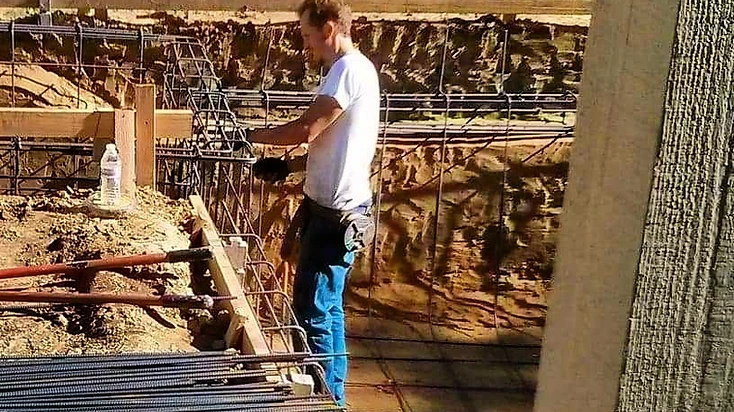
There is a machine for tying rebar. It weighs about five and a half pounds, it fires a wire tie in roughly half a second, and one of them costs about what a used truck costs. Anyone who ties steel for a living has a strong opinion about whether that trade makes sense. Most of those opinions are louder than the evidence behind them.
So I went and read the evidence instead. This is not a demo and not a paid review. What I did was collect what the manufacturers publish, what distributors actually charge, what independent tool testers measured, and what contractors write in forums after they have run a gun for a year — and put the source next to every claim so you can weigh it yourself. Prices are a snapshot from October 2026 and will drift; treat them as an order of magnitude, not a quote.
One note on sourcing before we start. A manufacturer's own specification is a fact about the tool; a manufacturer's own study about its tool is marketing. I have kept those two apart, and where a claim came to a magazine through the tool company, I say so.
What a rebar tier actually does
A battery-powered rebar tier is a handheld tool that forms a wire tie mechanically. You load a reel of that maker's proprietary wire into the magazine, insert the tool's mouth into the rebar intersection at roughly a 45-degree angle, and pull the trigger. The tool feeds the wire, loops it around the bars, twists it, and cuts it off. MAX, which invented the category in 1993 according to its own company history, describes the cycle that way in its published FAQ.
What that produces is a mechanical tie with a torque setting. MAX states plainly that “Each tie with a MAX rebar tying tool is equivalent to a 16 ga. hand snap tie,” and that the low profile of its TwinTier tie is short enough to let you tie over an existing tie for a double tie where the detail calls for one. Most tools on the market also offer several strength settings and a continuous mode, so you can fire tie after tie without releasing the trigger.
The learning curve is real but shallow. MAX says it takes about five minutes to learn to load a wire and form a tie. That matters more than it sounds: a tool that a first-week hire can run productively changes who you can put on steel.
Here is what a tier does not do. It does not place bar, it does not set cover, it does not choose spacing, and it does not read the plan. It ties bar that somebody already put in the right place. Hold that thought, because it is the part that decides whether any of this is worth the money.
The tools, and what they cost
Five makers matter in North America right now: MAX, Makita, BN Products, the cheap imported tier, and the pliers you already own. Specifications below come from the makers and their authorized distributors; prices are as listed by dealers in October 2026.
- MAX Re-Bar-Tier RB398 / RB398S — 21-gauge TW898 wire, #3x#3 to #5x#6 bar, three wraps, under one second per tie, about 3,500 ties per charge. Ohio Power Tool lists the RB398S at $2,932.91 as a special-order item.
- MAX TwinTier RB441T / RB443T — 19-gauge TW1061T twin wire, about half a second per tie, jaw capacity to #7x#7, roughly 4,000 ties per charge. Journal of Light Construction quoted about $2,700 for the RB441T in its 2020 review.
- MAX TwinTier RB611T / RB613T — the big-capacity end. MAX says the RB611T is the only battery tier on the market that will tie up to #9x#10 bar; a distributor listing for the newer RB613T quotes about half a second per tie and up to 5,000 ties per charge.
- MAX RB401T-E — the stand-up TwinTier built for flat steel, so a rod buster ties slab and deck mats without bending over. MAX quotes about 4,000 ties per charge.
- Makita XRT01 (18V LXT) — 21-gauge wire, 0.8 seconds per tie, up to 5,300 ties per charge on a 5.0 Ah pack at #3x#3, up to 120 ties per wire wheel, six tying-strength settings, single and continuous modes, 5.7 pounds with battery, three-year warranty. Home center list price on the 5.0 Ah kit is around $3,069; street pricing moves around a lot more than that.
- Makita XRT02 (18V LXT) — the deep-capacity version of the same tool, listed at about $3,249 for the kit.
- Makita GRT01 (40V XGT) — the first 40-volt 16-gauge rebar tier. Up to 3,600 ties per charge, deep tying capacity to #9x#8 bar, six tie-strength settings and a lock-off. Kit list price around $3,249.
- BN Products Tiger Tier BNT-40X — up to #6x#6 bar, 21-gauge wire, up to 128 ties per coil, up to 5,000 ties per charge, five tension settings, fully enclosed brushless motors, one-year warranty. Contractors Direct lists it at $1,842.75, with the smaller BNT-25X at $1,702.35 and the larger BNT-58X at $1,930.50.
- The imported tier — the same generic gun sold under a dozen brand names for roughly $250 to $300. A contractor on irate4x4 priced them this way: “there are apparently Thaihinduchiwanese versions that are cheaper than renting one.”
Notice the shape of that list. The real tools cluster in a band from about $1,800 to $3,300. The spread between the cheapest legitimate tool and the most expensive is smaller than the spread between any of them and a single day of a crew's time — which is the entire argument for buying one.
Speed: half a second is cycle time, not production
The advertised number is how long the tool takes to form one tie. That is cycle time, and it is the least interesting figure in the category, because nobody ties in a straight line all day. The gains that show up in a real week are different: you can tie without looking away, you can tie with one hand while the other holds bar, you don't lose quality when you get tired, and an inexperienced hand gets productive fast. Tim Uhler, who runs Pioneer Builders and has written about these tools for the Journal of Light Construction since reviewing the MAX RB397 in 2012, put the first one this way:
“It had drastically lowered the hours we spent tying rebar.”
“Two guys with guns can tie in an hour what it would have taken us all day to do.”
He is also careful about what that comparison is. MAX's promotional claim of being five times faster than hand tying held up for his crew, he wrote, “because we aren't professional iron workers.” That caveat is the honest part of the whole conversation, and it cuts both ways. Read the claim as five times faster than a framing crew tying by hand — not five times faster than an ironworker who ties steel for a living. The same review makes the economic argument I find more convincing than the speed claim:
“A starting wage earner with an expensive gun is more economical than a high dollar guy who's still not as fast as I would be with a gun.”
The trade's own veterans make the opposite case, and I think they are right on their own ground. A skilled hand-tier with a wire reel and pliers is extraordinarily fast, and a gun does not beat him on a long straight run of large bar. From the forums, unprompted:
“Never seen a rod buster run a gun, always a spool and kliens.”
“My old man runs a few guns. They do work. Were nice for doin slabs, not so much walls.”
That second line is the most useful sentence I found anywhere in this research. Guns are strongest on flat, open, repetitive mats — slabs, decks, footing grids, mats on grade — and weaker as the work gets vertical and tightly detailed. Which is, more or less, a description of where a pool shell sits.
Wire refills: the subscription you're signing
This is the part buyers underweight, and it is where the tool makers actually make their money. Every one of these guns uses proprietary wire on proprietary reels. MAX is blunt about it in its own FAQ: “Generic wire cannot be used with MAX rebar tying tools,” and ordinary 16 or 16.5-gauge bulk hand tie wire is not compatible with any MAX tier. The wire is also not interchangeable across a maker's own lines — the 21-gauge TW898 reels that feed the RB398 series will not run in a TwinTier, which takes 19-gauge TW1061T, and the TwinTier wire will not run in the older tools.
So the real cost per tie is coil price divided by ties per coil, and both numbers vary with the bar you're tying. Here is the arithmetic, using current dealer pricing and the maker's own published tie counts:
- 21-gauge TW898, for the RB398-class guns and the Makita 18V tools: a 50-roll case runs about $314 to $319, which is roughly $6.30 per roll. MAX publishes 75 to 210 ties per roll depending on bar size, so that is roughly 3 to 8 cents per tie.
- 19-gauge TW1061T, for the TwinTiers: a 30-coil case runs $319.34, or about $10.65 per coil, with 145 to 265 ties per coil depending on bar size and tool — roughly 4 to 7 cents per tie.
- 16-gauge TW1525, for the large older MAX tools: MAX publishes 120 to 230 ties per coil.
Three to eight cents a tie is not the thing that breaks a job. It is the thing that eats a budget quietly, because ties run in the thousands. A crew that fires 2,000 ties in a week is spending somewhere between $60 and $160 on wire, every week, forever. Compare that to hand tying: a third-party estimating guide puts bulk black annealed tie wire at roughly $30 to $50 per 100-pound coil, and budgets 250 to 350 pounds of wire for a 50-ton rebar job — call it $75 to $175 in consumables for the whole job. The consumable is not where hand tying wins. The labor is.
What you should buy is the wire the tool was built for, and this is one of the few places where the field reviews and the manufacturer agree without qualification:
“We learned the hard way not to buy the cheaper wire you can find on Amazon. Even the Makita wire that came with the gun made the motor sound like it was bogging down compared with Max wire.”
He buys MAX wire for both his MAX and Makita guns, because his local supplier stocks it. That is a practical rule worth copying: standardize the wire you stock, and only on a reel the tool is rated for.
Durability: how they fail, and what service looks like
Nobody in this trade complains that a rebar tier is fragile. They complain that it jams, and the causes are consistent across every source I read: the wrong wire, dirt in the mechanism, moisture, and rust working on the gears. The same review that praises these tools explains the failure mode plainly:
“Rebar tyers in general can be prone to misfiring if you don't use the right wire, or if dirt and water get into the gears.”
Both MAX and Makita have responded to that with enclosure. Uhler noted that MAX sealed the newer TwinTier better than the older RB397 he bought in 2014, keeping the wire rolls out of the weather, and that Makita uses a clear cover over the wire wheel on its 18V tool. BN Products advertises fully enclosed brushless motors on the BNT-40X — and, to its credit, publishes its own fault-and-fix chart for the Tiger Tier series, which tells you exactly what owners run into: feed faults, wire breaks, twist problems and battery faults.
The rest of the maintenance advice is ordinary and easy to ignore: wipe the tool down and clear debris at the end of the day, don't run it in the rain, and don't degrease it, because rust accelerates gear wear. That is MAX's own guidance, and it matches what the repair threads look like years later.
“The darn thing twists the wire too tight and breaks it every now and then and I cannot figure out what is causing it to do this.”
“Having the same issue with one of mine. I think the power adjuster has gone bad.”
Note what failed there — the tension setting, not the motor. On a tool whose whole job is a consistent twist, an out-of-calibration adjuster produces weak ties or snapped wire. That is a maintenance item, and it is why the tension setting deserves a check rather than a set-and-forget.
The clearest durability comparison from the field is a 2011 ContractorTalk thread that still reads true, from a member running several guns:
“We have a few of the Max guns, a few smaller ones and one larger. They are expensive but work pretty well. They also tie at least 2-3 times faster. All of the other brands of guns we've had have ended up not working correctly after a while. The Max guns we have usually work well and they are easy to get parts for.”
Parts availability is the underrated half of that quote. MAX runs service centers in New York and Texas with an authorized dealer network, and lists a one-year manufacturing warranty on its tiers. Makita lists three years on the 18V XRT01. If you buy the cheapest tool in this category, understand that the warranty is short, the parts chain is thin, and the failure mode is a crew standing around while somebody clears a jam.
What buyers and crews actually say
Here is an uncomfortable fact about this category: there is very little verified purchaser feedback to read. The RB398S listing at Ohio Power Tool shows zero customer reviews. The BNT-40X listing at Contractors Direct says “Be the first to write a review.” The one Amazon listing that shows a large rating count is an aggregated brand page, not a review set for a specific tool — which is exactly the kind of number that should make you suspicious rather than comfortable. So the useful signal is in the forums, from people describing tools they own. Two threads on Reddit cover the ground most often:
“So I currently use the MAX RB441T rebar tie gun. I love it. Saves me so much time.”
“I've used the makita and it's a solid tool. But you'll never beat nips for tie wire. Guns just don't get it tight enough imho.”
That second comment is the objection most worth taking seriously, and it is about feel rather than specification. The maker's answer is that the tie is equivalent to a 16-gauge hand snap tie with a torque dial to adjust it. My answer is that tightness is not the thing that holds a cage — bar position is — but if your engineer calls out a specific tie, tie it that way. Where a tool's tension setting is wrong for a detail, the tool is the problem, not the detail.
“The Maxx twin tie is the best on the market without a close second. It is a more expensive tool, but uses less wire, is faster, ties tighter…”
“Much more reliable. Still jams here and there but much easier to fix and get going again. It is definitely worth it if you're tying a lot of bar…”
“Saying it pays for it self is an understatement, the time saved is insane.”
The imports get their own verdict, and it is consistent: they work, they jam, and clearing a jam is expensive in a way the purchase price hides.
“Ive had a problem with the cheaper ones jamming. Then you spend 10 minutes trying to get the damn thing cleared. It was almost always faster with the pull twister.”
The same thread produced the analogy I would use if you asked me whether to buy one:
“I was looking at it like a pneumatic nail gun. Yes, you can get a lot done with a hammer and a pouch of nails, but a nail gun makes a hell of a difference and an older body doesn't feel nearly the toll at the end of the day. But like a cheap nail gun, if it is jamming all the time it isn't going to be worth it.”
On the specific question of the BN Products tool, the only user account I could find was short and specific:
“They jam every once in a while which means taking the tip apart and removing the jammed wire which isn't too bad just annoying…”
Which lines up with the manufacturer's own troubleshooting chart existing in the first place.
The endorsements, and how to read them
Trade magazines carry plenty of glowing contractor quotes about these tools. Most of them arrive through the manufacturer, and that is worth stating plainly rather than pretending otherwise. For Construction Pros published a 2020 feature on tying tools that included testimonials sourced through MAX — including a Florida contractor whose job that would have taken a crew of six a full day was finished by two men in three hours, and a cost-savings analysis MAX ran for that contractor that put the annual savings at more than $145,000.
Those are the most aggressive numbers in this entire review, and they come from the tool company's own analysis for a high-volume steel contractor. Read them as a ceiling, not a promise. The same article carries these, which I find more useful because they describe why the tools stuck:
“Rebar installation is 60% of our work and the TwinTiers are the most important tools in our arsenal.”
“This tool is giving our team the freedom to focus on other project efforts and laying out more rebar while cutting our time down in half.”
“Laying out more rebar” is the sentence to underline. What the tool buys is not only tied steel — it is tied steel without the person tying it being the bottleneck on everything else that day.
The independent testing verdict is narrower and, for that reason, more trustworthy. Pro Tool Reviews, testing Makita's 18V tool rather than writing up a press release, summed it up as:
“This isn't the first cordless rebar tie tool to hit the market, but it is among the major power tool manufacturers that have a deep line of other products on the same battery platform. The major win here is in productivity.”
Battery platform is the quiet differentiator nobody advertises as one. Uhler's complaint about his MAX gun is not about speed: “With the Max gun, we have only one battery, which doesn't work on any other tools and takes about 45 minutes to recharge.” A Makita tier runs on the batteries already in your truck. On a long day, that is worth real money.
The injury argument, which is the strongest one
The most credible case for these tools has nothing to do with cycle time. It is the back. For Construction Pros reported a 2003 NIOSH study of 1,000 ironworkers in which, as MAX's product marketing executive described it, “They found out that 56% of them were experiencing some sort of MSD in their lower back,” with carpal tunnel and other repetitive-strain injuries common alongside it. At World of Concrete in 2020, the same source reported that 86% of visitors to the booth said they had experienced back issues, and 56% said those issues had been severe enough to keep them off work.
I have no interest in overselling that. It is manufacturer-reported, and the survey data is old. But it matches what every rodbuster knows and what the irate4x4 thread got to in its own blunt way — one poster's reaction to what rod busters do all day was simply, “My back hurts just thinking about it.” A tool that keeps a trained hand in the trade for another decade is not a luxury, and no cost-per-tie calculation captures it.
It also changes the quality math in a way worth naming. As Uhler wrote, the person tying is often the lowest-paid hand on the job, which is exactly how a lot of us started: “A gun makes it much easier to get it right.” On work where a failed inspection costs a week — and in his words, “each day lost on the schedule adds three days to the job” — the cheapest insurance is steel that was tied consistently by someone who was not exhausted.
How I'd read all of this for a pool shell
A pool shell is not a slab, and this is where a review like this has to stop being a spec sheet and start being a judgment about the work. A shell is curves, radii, benches, steps, a dam wall, a cover box, wall curtains set inside formwork, and plumbing penetrations running through the mats. The tool's limit on that work is rarely speed. It is reach — whether the jaw can land on the intersection at the angle it needs.
So on a shell, the useful questions are narrower than the marketing ones. Can the tool get to the connection, or is that a pliers tie? Does the tension setting match the tie the drawings call for? Does the wire on that reel produce a tie that satisfies the engineer of record — and if a specification has to be submitted, the manufacturer has to document the wire for that project. And the biggest one: none of this changes cover, spacing, laps, hooks, or where the bars sit. A gun ties the bar it is given. If the bar is set wrong, it will tie wrong steel beautifully.

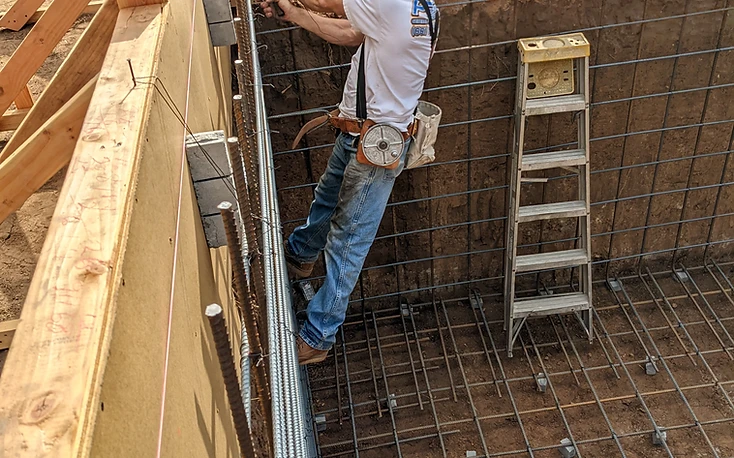
My reading of the record is that a tier is a genuine productivity tool on wide, flat, repetitive mats — footing grids, deck steel, slab mats — and a partial tool on a detailed shell, where a skilled hand-tier with pliers still wins the corners, the penetrations, and the tight detail inside formwork. Where it earns its keep is not the half-second cycle. It is that it makes a clean, consistent tie easy for whoever is holding the tool, on the parts of the job it can reach.
The bottom line
- Price the wire before the tool. Coil price divided by ties per coil is your real consumable, and it runs roughly 3 to 8 cents a tie across these tools. A cheap tool with expensive wire is not a cheap tool.
- Buy the wire the maker rated the tool for. Every field source that mentioned jams put bad or mismatched wire near the top of the list, and the manufacturers state flatly that generic wire is not compatible.
- If you tie #9x#10 bar, the choice is effectively made for you: MAX says the RB611T is the only battery tier on the market with that capacity.
- If you already run Makita batteries, the platform math is real — the 18V XRT01 and XRT02 and the 40V GRT01 share your packs, and the 18V tool carries a three-year warranty against MAX's one year.
- If your volume is low, rent or buy used before buying cheap. The $250 to $300 imports work, jam, and cost you ten minutes of a crew each time they do. A used name-brand gun with dealer parts behind it is the better gamble.
- And if you tie a lot of vertical wall steel and tight detail, be honest about it. Every forum veteran in this review said some version of the same thing: guns are great on mats, and the spool and pliers never quit.
None of that replaces the plan. The tool changes how fast a tie gets made. It does not change what the tie has to hold, and it cannot fix a bar that was set in the wrong place. On the work I care about, the ordering is simple: layout first, cover second, tie quality third, and the tool somewhere after that — useful, expensive, and never the point.
Common questions
Are rebar tying guns worth the money?
For high-volume, repetitive steel — footing grids, slab and deck mats, long runs of horizontal bar — the field evidence says yes. Crews report tying two to three times faster, and contractors report jobs that took a six-man crew a full day finishing with two men in three hours. For low-volume and tightly detailed work, the picture is murkier: professionals point out that a skilled hand-tier with pliers is extremely fast, and the imported $250 to $300 tools jam often enough to cost more than they save. The deciding factor is how many ties you make in a year, not how fast the gun is.
Can I use ordinary bulk tie wire in a rebar tier?
No. Every tool in this category uses the maker's proprietary wire on proprietary reels. MAX states in its own FAQ that generic wire cannot be used with MAX rebar tying tools and that 16 or 16.5-gauge bulk hand tie wire is not compatible with any MAX tier. The wire is also not interchangeable between a maker's own models — the 21-gauge TW898 reels for the RB398 series will not run in a TwinTier, which takes 19-gauge TW1061T. Using the wrong wire is the most commonly reported cause of misfires.
What does the wire actually cost per tie?
Roughly 3 to 8 cents, depending on the tool and the bar size, and it is worth running the arithmetic before you buy. A 50-roll case of 21-gauge TW898 runs about $314 to $319, which is about $6.30 a roll, and MAX publishes 75 to 210 ties per roll depending on bar size — about 3 to 8 cents a tie. A 30-coil case of 19-gauge TW1061T for the TwinTiers runs $319.34, about $10.65 a coil, with 145 to 265 ties per coil — about 4 to 7 cents a tie. On a job making thousands of ties, that adds up weekly.
Do machine ties hold as well as hand ties?
MAX states that each tie made with its tool is equivalent to a 16-gauge hand snap tie, and its tools have a torque adjustment dial to set how tight the tie is formed. In practice, experienced hands still prefer pliers in tight detail and on some vertical work, and one common forum objection is that guns do not get the tie as tight as a good hand-tie feels. Where the drawings specify a particular tie, the specification governs — and a tool whose tension setting is out of calibration should be serviced, because an over-tightened tie can snap the wire.
What breaks on a rebar tying gun, and what does service look like?
The consistent failure is jamming, caused by the wrong wire, dirt in the mechanism, moisture, or rust on the gears. The published maintenance guidance is to wipe the tool down and clear debris daily, keep it out of the rain, and avoid degreaser sprays, since rust accelerates gear wear. Over-tightening that snaps wire is usually a tension adjustment or power-adjuster fault rather than a motor fault. On support: MAX lists a one-year manufacturing warranty with service centers in New York and Texas plus dealer parts, Makita lists three years on its 18V tying tool, and BN Products publishes its own fault-and-fix chart for its Tiger Tier machines.
Does a tying gun make sense on a pool shell?
Partly. A pool shell is curves, radii, benches, steps, dam walls, cover boxes, wall curtains inside formwork and plumbing penetrations — so the tool's limit is usually reach rather than speed, and hand tying with pliers still wins the corners, the penetrations and the tight detail. Where a tier pays off is on the wide, flat, repetitive mats: footing grids, deck steel and slab mats. What no tool changes is cover, spacing, laps, hooks, or where the bars sit. A gun ties the bar it is given; it cannot fix steel that was set wrong.
A second-generation rodbuster carrying a family reinforcing-steel lineage from Southern California to southeastern Pennsylvania. A family reinforcing-steel lineage dating to 1986 — now building in southeastern Pennsylvania.