The Risks of Poor Pool Rebar Craftsmanship in Pennsylvania
Bad steel work doesn't fail the day it's installed. It fails years later, from the inside of the shell. Here are the real risks of minimum pool rebar in Pennsylvania.
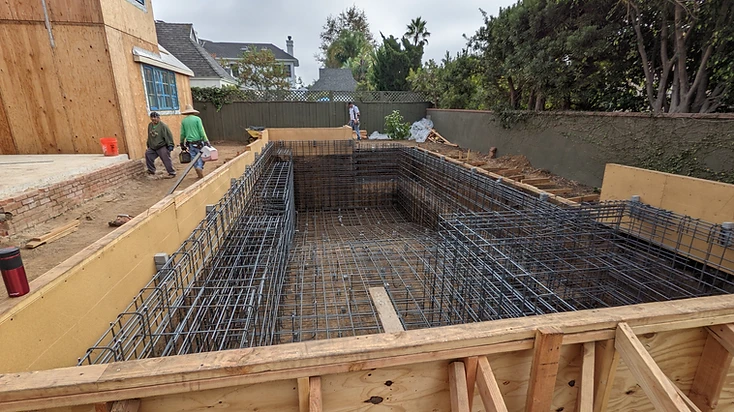
Reinforcing steel is the one part of a pool that is designed to be buried. The gunite or shotcrete covers the floor mat, the wall curtain, the bond beam, the steps, the cover box — everything I tie. That means poor steel work doesn't fail on the day it's installed. It fails years later, usually after the warranty conversation is closed, and usually in a way the owner blames on the plaster.
I've spent a lifetime in this trade in two very different markets, and the pattern is the same in both places: the work that gets covered is the work that gets shortcuts. Here is what those shortcuts actually risk, and why Pennsylvania is an unforgiving place to gamble on them.
Why bad steel work is a delayed risk, not a avoided one
A cage tied to the minimum still looks like a cage. That is exactly what makes it dangerous. The shortcuts don't announce themselves — they hide inside the concrete and start a clock:
- Cover is lost, so moisture and chlorides reach the steel instead of being held away from it.
- The steel corrodes. Corrosion products take up more volume than the steel they replace, so the concrete around them has to move.
- The shell cracks or spalls from the inside, which lets water in faster and accelerates the cycle.
- By the time it's visible — rust weeping through finish, tile lifting, a crack that keeps coming back — it is no longer a surface repair.
In southeastern Pennsylvania that clock runs faster than most builders expect. The next section is why.
Risk one: not enough cover, in a climate that punishes it
Cover is the distance between the outside of the bar and the outside of the concrete. It is not cosmetic. Concrete is alkaline, and that alkalinity is what protects embedded steel from corrosion — the steel has to sit far enough inside the concrete for that protection to hold. When a cage sags into the soil or is tied tight against the form, the shell ends up with less cover than the engineer specified, and the steel is now relying on concrete that isn't there.
Now add our climate. We build pools that get saturated, get chlorinated, and sit through hard freezes. Freeze-thaw cycling works on every crack and every thin spot in a shell, and de-icing salts near a pool deck put chloride on the concrete on top of everything the pool itself contributes. A shell that might tolerate marginal cover in a mild climate will find that marginal cover out here. You don't get a warning with cover loss — you get rust bleed, pop-outs, and eventually delamination.

Risk two: a cage that drifts off the layout
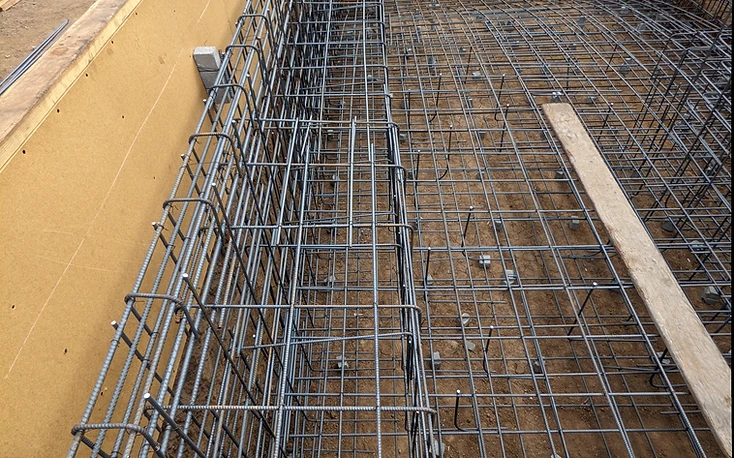
Spacing is a structural number, not a guideline, and it's the easiest thing in the trade to lose. Nobody pulls the string tight, a bar gets kicked off line, and an inch of drift becomes two across the floor. Verticals get set by eye instead of off the perimeter line, so the wall steel wanders and cover changes from one end of the shell to the other.
What that buys you is localized weakness you cannot see and cannot measure later. Pool shells crack where the geometry concentrates stress — the floor-to-wall junction, the deep end transition, steps and benches, the top of the wall line. Those are precisely the places where drifted spacing and thin cover do the most damage.
Risk three: loose ties and a cage that moves during the shoot
There's a theory in the field that the concrete will hold the cage, so ties can be skipped or spun loose. It doesn't work that way. Shotcrete and gunite arrive with real force, and a cage that isn't tied rigidly moves under it. When bars rattle or shift, the material doesn't wrap them the way it should — you get poor encapsulation and voids behind the steel, and the bars that were supposed to be protected are now exposed to exactly what you were trying to keep out.
A rigidly tied cage also holds its own cover. That's the part most people miss: the ties aren't there to satisfy an inspector, they're there to keep the steel where the engineer put it while the concrete is being placed around it.
Risk four: a bond beam that isn't continuous
The bond beam is the ring of steel that ties the top of the shell together. It's what keeps the shell behaving as one structure instead of a floor and a set of walls. When bond-beam bars are cut short, spliced carelessly, or substituted with whatever was on the truck, that ring is compromised at the perimeter — and the failure shows up at the surface, where it's most visible and most expensive to fix: cracking around the top of the wall, tile and coping problems, and a bond-beam line that never really closes.

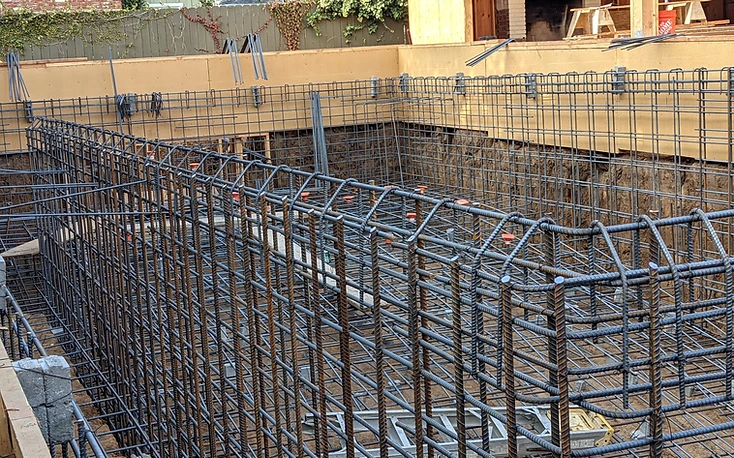
Risk five: steel and plumbing that fight each other
Returns, skimmers, main drains, light niches, spa dam walls, the cover box — every one of those is a place where steel and plumbing have to be coordinated, and every one of them is a potential crack path if they aren't. Steel detailed around a penetration and tied back into the surrounding mat behaves. Steel that gets shoved aside to make room for a fitting, with the bars cut and never replaced, creates a hard discontinuity in the shell right where water is concentrated.
This is also the failure that's hardest to diagnose later. A crack at a fitting looks like an equipment problem, a leak looks like a plumbing problem, and the actual cause — reinforcement that was cut for convenience and never made good — is buried in the shell where nobody is looking.
Risk six: an inspection that stops the job
The most immediate risk of minimum work is the one that arrives before the concrete does. Steel that's off layout, short on cover, or missing chairs is a failed inspection — which means rework, a re-inspection, a delayed shoot, and a gunite or shotcrete crew standing around or rolled to another job. That is the good version of this risk. The bad version is the cage that passes, because the scrutiny isn't uniform and a cage that looks like a cage can get a nod it didn't earn.
The real quality check in this trade is supposed to be the next trade — the crew that has to shoot against the steel. When that check is live and independent, it does more to hold rodbusters to the details than any single inspection does. When it isn't, the minimum slides through.
Risk seven: the repair you can't make
Here is the risk that outweighs all the others. You can re-plaster a pool. You can re-tile it, replace equipment, chase a leak, resurface a deck. What you cannot do economically is change the steel. Once the shell is shot, the cage is the structure for the life of the pool, and correcting it means demolition or serious structural intervention — not maintenance.
That asymmetry is the whole argument. The steel phase is a small fraction of the build, and it's the one phase where a mistake is permanent. Everything downstream can be redone. This can't.
Risk eight: whose problem it becomes
In practice, shell problems land on the builder. The owner calls whoever built the pool, not whoever tied the steel, and a crack or a delamination years in is a conversation about the finish even when the cause is underneath it. Reputationally and commercially, that risk usually sits with the party who had the least visibility into the steel — which is why it's worth being deliberate about who installs it.
How to protect yourself
- Ask for the steel details, not just the plan set. Bar size, spacing, cover, and the bond beam should be specified, not left to the crew.
- Ask how cover is held. The answer should be chairs, spacers, and a cage rigid enough to keep its shape while it's shot.
- Ask for photographs of the cage before the concrete goes on. It takes two minutes and it's the only record of that work that survives.
- Ask whether the steel is inspected before the shoot, and ask to see the result.
- Ask what the rodbuster answers to. If the same company digs, ties, and shoots, the trade that would normally flag bad steel answers to the same bottom line.
- Ask for references. References are available on request, and builders and engineers who have watched the work are the best evidence there is.
The standard I build to
My standard is not complicated. The cage should look like something before it disappears: bars on layout, spacing held, cover held, ties tight, the bond beam continuous, the dam wall built as a dam wall, the plumbing detailed instead of dodged. I install to the detail on the page because that is what the shell is going to rely on for the next several decades — and because the work under the finish is the work that decides whether the finish lasts.
Psalm 127:1 says that unless the Lord builds the house, the builders labor in vain. I read that as a standard rather than a slogan: the part nobody sees is the part that carries everything above it. That's why I build it as if it matters — because it does.
Common questions
What happens if pool rebar doesn't have enough cover?
The concrete is no longer protecting the steel. Concrete's alkalinity is what keeps embedded steel from corroding, so when cover is thin or missing, moisture and chlorides reach the bar. The steel corrodes and expands, which cracks or spalls the concrete from the inside. In a freeze-thaw climate like southeastern Pennsylvania that process runs faster, and it shows up as rust bleed, pop-outs, and delamination rather than a clean crack you can chase.
Can poor rebar work be corrected after the pool is shot?
Not economically. Plaster, tile, equipment, and decking can all be redone, but the cage becomes the structure of the shell the moment concrete is placed against it. Correcting it later means demolition or serious structural intervention. That's why the steel phase is the one phase where the work should be verified before it's covered.
Is pool reinforcing steel inspected in Pennsylvania?
Requirements vary by jurisdiction, and the level of scrutiny varies with them. Some departments inspect the steel before the shoot, some rely on the engineer of record, and some reviews are brief. Because a cage that looks like a cage can pass a quick look, the most consistent check in this trade is the next trade: a gunite or shotcrete crew that is willing to refuse to shoot steel that isn't right.
Why do pool problems show up as cracks if the cause is the steel?
Cracks are how a shell tells you where stress went. Spacing that drifted off layout, a bond beam that isn't continuous, or steel cut around a fitting all create weak spots or hard discontinuities, and the shell cracks where the stress concentrates — the floor-to-wall junction, steps, the perimeter, or around a penetration. The visible crack is usually the last step in a chain that started under the concrete.
How can I tell whether my pool's steel was installed properly?
Ask for photographs of the cage taken before the shoot, ask what cover and spacing the engineer specified, and ask who inspected the steel and what the result was. A properly built cage looks organized: bars on layout, consistent spacing, chairs in place, ties tight, a continuous bond beam, and plumbing that was detailed around rather than cut through.
A second-generation rodbuster carrying a family reinforcing-steel lineage from Southern California to southeastern Pennsylvania. A family reinforcing-steel lineage dating to 1986 — now building in southeastern Pennsylvania.